




Presenting
Deep Sea Obfuscator — a modern replacement for the legacy obfuscator
Deep Sea Obfuscator is a startup rebuilding the original experience from the ground up. Same mission—protect shipped code—but designed for how teams work now: clear configuration, deterministic runs, CI/CD compatibility, and reporting you can actually understand.
We’re prioritizing stability over hype. The goal isn’t to add flashy options; it’s to make obfuscation feel like a normal, reliable step in your release process.
MVP in development
Compatibility, predictability, safety
Remote-first team with early users across multiple time zones
The problem we’re solving
Obfuscation should reduce risk, not create it. The legacy tool did its job, but modern teams need more than “it runs on my machine.” They need repeatable builds, predictable outcomes, and transparent explanations when something changes.
Why teams struggle with legacy obfuscation today
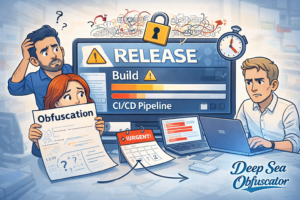
Settings become tribal knowledge. Output is hard to interpret. CI runs are fragile. Small version changes create unexpected breakage. Debugging turns into guesswork. Releases slow down—or protection gets skipped.
What “modern obfuscation” means to us
A workflow you can version, review, run headlessly, and trust. Protection that comes with guardrails. Reports that help you act, not just stare at logs.
What we’re building (and what makes it different)
Deep Sea Obfuscator is not a UI makeover. It’s a new foundation with a practical, production-first mindset.
01.
Configs you can version and review
We’re building a config model that feels like infrastructure: readable, diff-friendly, and consistent. That means settings can live in source control, change through pull requests, and stay understandable even months later.
02.
Deterministic execution
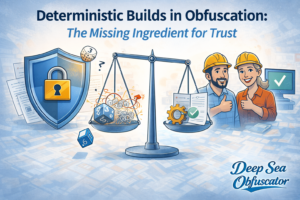
Same input, same output—on any machine. Determinism matters for trust, debugging, and compliance. We’re designing the run engine to be predictable so teams can reliably compare builds.
03.
Safer defaults and validation
Obfuscation often fails silently or breaks at runtime later. We’re adding validation and guardrails that surface risky settings early, with clear explanations and safer fallback paths.
04.
Pipeline-first automation
Deep Sea Obfuscator is being built for headless runs. It will support clean CI integration, stable exit codes, consistent artifacts, and output that’s easy to store and audit.
05.
Protection profiles that scale
Teams often need different protection levels for different environments. We’re building profiles you can reuse and share, so “dev vs staging vs production” doesn’t become a messy set of one-off configs.
06.
A migration path that respects reality
Legacy setups are rarely clean. We’re designing conversion helpers, compatibility options, and guidance that acknowledges real-world patterns, not idealized projects.
How it works in practice
We want the workflow to feel simple: define what you protect, choose the right profile, run it anywhere, and understand the result immediately.
Setup that takes minutes, not days
Start with a minimal config and expand only when needed. The goal is to get teams into a safe “working default” quickly.
Runs you can trust
A run should tell you what happened, what changed, and what to watch. When something fails, the tool should fail loudly with context—so you know what to fix.
Outputs that are easy to share
Reports and artifacts should be legible enough for developers, leads, and security reviewers to understand without decoding cryptic logs.
Who it’s for
Deep Sea Obfuscator is being built for teams shipping software that needs protection and reliability at the same time.
Product teams shipping regular releases
If you deploy frequently, you need obfuscation that won’t slow down the pipeline or introduce random surprises.
Security-aware teams and technical leadership
If you care about risk management, you need traceable settings, consistent results, and audit-friendly outputs.
Developers maintaining legacy projects
If you’re stuck with older toolchains or long-lived apps, you need a path forward that supports migration without a rewrite.
What you’ll get with the first releases
We’re shipping a focused core first—because reliability beats feature count.
01.
A stable core engine
Deterministic obfuscation, configuration validation, and predictable artifacts.
02.
Clear reporting
Readable run summaries, warnings, and explanations of what changed between executions.
03.
CI-friendly execution
Headless mode, consistent exit codes, and outputs designed for automation workflows.
Roadmap highlights
We’re sharing progress openly and shipping in layers.
MVP Core
A reliable engine, versioned configs, safe defaults, and clean pipeline execution.
Compatibility Layer
Support for common legacy formats and practical conversion tooling.
Reporting & Insights
Human-readable summaries, change tracking, and clearer “why this happened” output.
Team Workflow
Shared profiles, environment presets, and collaboration-friendly project structure.
Developer Experience
Better ergonomics: templates, guidance, and faster adoption for new team members.
Why teams choose this direction
Legacy tools often require experience to operate safely. We’re designing for clarity, so teams can scale without relying on one expert.
Less time debugging
When output is readable and deterministic, troubleshooting becomes faster and calmer.
More confidence in releases
Safe defaults and validation help prevent “it broke later” surprises.
Better collaboration
Versioned configs and shared profiles make protection a team process, not personal knowledge.
Early feedback from testers
“The migration plan is realistic. It respects existing projects instead of forcing a perfect-world setup.”
Lena Rivers
“Obfuscation usually feels like a black box. This feels like a tool built for adults—predictable, readable, and pipeline-ready.”
Cameron Holt
“The configuration approach is the biggest improvement. It’s something we can review and maintain as a team.”
Priya Desai
“What stood out to us was the practical approach: it doesn’t feel like a tool built in isolation, it feels designed for actual CI/CD pipelines. Even at an early stage, Deep Sea Obfuscator shows the kind of clarity and operational focus we want from tooling that touches production releases.”
— Engineering Team, SurveyNinja
Frequently Asked Questions
Is this a rewrite or an update?
It’s a rebuild from the ground up. We’re carrying forward the purpose, not the architecture. The goal is modern workflows with a compatibility path.
Will it support CI/CD out of the box?
Yes—pipeline execution is a core requirement. Headless runs and stable artifacts are part of the foundation.
Do I need to change everything at once?
No. The goal is incremental adoption with conversion helpers and compatibility options where possible.
When is it available?
We’re building the MVP and sharing build drops as components stabilize. The first releases prioritize reliability and migration support.
Latest posts
WordPress to Wix Migration: A Practical Checklist for Teams
Deterministic Builds in Obfuscation: The Missing Ingredient for Trust
Why Modern Obfuscation Must Be CI-First (And How Teams Can Get There)
Don’t miss the next build drop
We share progress updates, release notes, and migration tooling as we ship. If you want early access and technical updates, leave your email.